
News & Events
What is Agentic Browsing? A Complete Guide to Google’s New Lighthouse Score 2026
No Comments
Introduction: What is Agentic Browsing?
What is Agentic Browsing? Artificial Intelligence is rapidly changing how people interact with websites. Instead of manually browsing multiple pages, users increasingly rely on AI assistants such as ChatGPT, Google Gemini, Claude, Microsoft Copilot, and Perplexity to search, compare, summarize, and even complete tasks on their behalf.
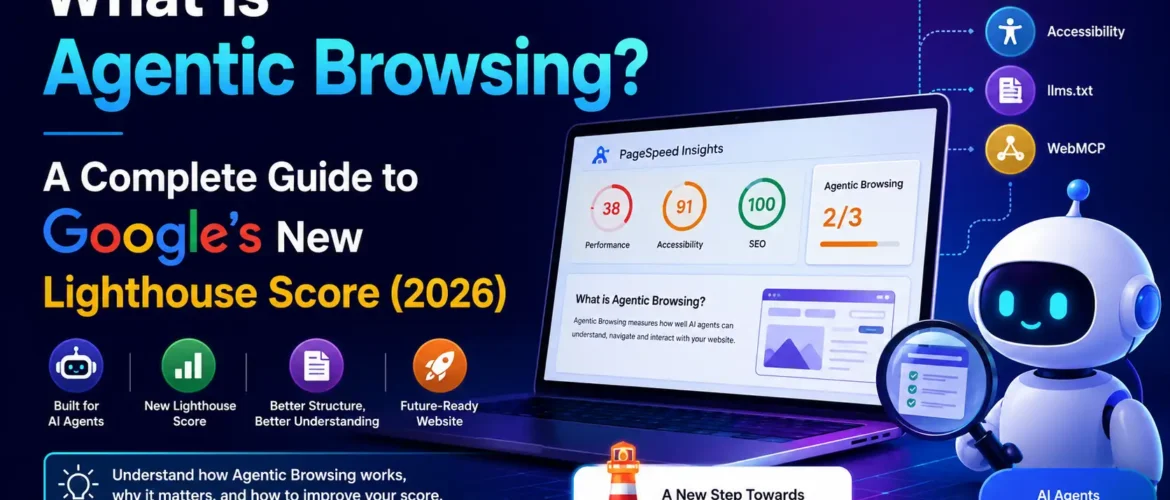
To support this shift, Google Chrome has introduced a new Agentic Browsing category in Lighthouse. Unlike traditional SEO metrics that evaluate search engine optimization, Agentic Browsing measures how effectively AI agents can understand and interact with your website. The feature is currently experimental and focuses on actionable readiness checks rather than a 0–100 score.
Table of Contents
- What is Agentic Browsing?
- Why Google Introduced It
- How Agentic Browsing Works
- Current Scoring System
- Difference Between SEO and Agentic Browsing
- Core Evaluation Factors
- How to Improve Your Score
- HTML Examples
- WordPress Optimization
- Common Mistakes
- Future of Agentic SEO
- Frequently Asked Questions
What is Agentic Browsing?
Agentic Browsing refers to a website’s ability to support AI-powered agents that browse, understand, and interact with pages on behalf of users.
Unlike traditional search engine crawlers that mainly index content, AI agents can:
- Read page content
- Understand page structure
- Click buttons
- Complete forms
- Navigate menus
- Compare products
- Book appointments
- Download documents
- Answer user questions
Think of an AI assistant helping a user find a digital marketing course. Instead of simply reading your homepage, it may attempt to locate the course syllabus, compare fees, identify placement support, and submit an enquiry form. A site that is semantically structured and accessible is easier for the agent to understand and use.
Why Google Introduced Agentic Browsing
The web is evolving from search-first to AI-first experiences.
Previously:
User
↓

Google Search

↓

Website
————————————————-
Today:
User

↓

AI Assistant

↓

Website

↓

AI summarizes

↓

User
As AI assistants become common entry points to the web, websites that are easier for automated agents to interpret may provide better experiences.
How Agentic Browsing is Scored
Unlike other Lighthouse categories:
- Performance (0–100)
- Accessibility (0–100)
- SEO (0–100)
Agentic Browsing uses a pass ratio, such as 2/3 or 3/3, rather than a weighted percentage score. This reflects how many readiness checks your site passes, because the standards are still evolving.
Example:
Performance
38

Accessibility
91

SEO
100

Agentic Browsing

2/3
This means:
- Two checks passed
- One check failed
Main Factors Google Evaluates
1. Accessibility Tree
AI agents rely heavily on the browser’s accessibility tree to understand interactive elements.
Google checks whether:
- Buttons have names
- Inputs have labels
- Roles are valid
- Interactive elements are exposed to assistive technologies
Poor example:
<input placeholder="Name">Better example:
<label for="name">Full Name</label>

<input
id="name"
name="name"
type="text">
2. Semantic HTML
AI understands semantic HTML much better than generic <div> elements.
Poor example:
<div onclick="submitForm()">
Submit
</div>
Better example:
<button type="submit">
Submit
</button>
3. Page Stability (CLS)
If page elements move unexpectedly while loading, AI agents may lose track of the intended target. Lighthouse therefore considers visual stability (Cumulative Layout Shift) as part of agent readiness.
Example of a layout shift:
Button

↓

Image loads

↓

Button moves

↓

AI clicks wrong location
4. llms.txt
Google’s experimental checks also look for an llms.txt file at the root of your domain. This file provides a machine-readable summary intended for AI agents. It is not currently a search ranking factor, but Lighthouse treats it as one of the readiness signals.
Example:
https://example.com/llms.txtSample:
# Company

KingofSEO

## Services

SEO Training

Digital Marketing

Web Development

AI Courses

## Contact

https://example.com/contact
5. WebMCP
WebMCP (Web Model Context Protocol) is an experimental mechanism for exposing tools and actions directly to AI agents. Lighthouse can verify registrations for supported implementations, although the audit currently depends on Chrome’s origin trial.
SEO vs Agentic Browsing
| SEO | Agentic Browsing |
|---|---|
| Optimizes for search engines | Optimizes for AI agents |
| Focuses on keywords | Focuses on understanding and interaction |
| Crawling and indexing | Task completion and usability |
| Meta tags | Semantic HTML and accessibility |
| Backlinks | Machine-readable structure |
| SERP visibility | AI assistant compatibility |
Best Practices
Use Proper Heading Structure
Poor:
H3

H1

H4
Correct:
H1

H2

H2

H3
Example:
H1

Digital Marketing Course

H2

Course Overview

H2

Curriculum

H2

Placements

H2

FAQs
Descriptive Buttons
Avoid:
Click HereUse:
Download Brochure

Book Free Demo

Enroll Now

Call Admissions
Add Image Alt Text
Poor:
<img src="seo-course.jpg">Better:
<img
src="seo-course.jpg"
alt="Students attending Digital Marketing Training in Chennai">
Improve Form Accessibility
Use labels:
<label>Email</label>

<input
type="email"
autocomplete="email">
Add Autocomplete
<input autocomplete="name">

<input autocomplete="email">

<input autocomplete="tel">
Improve Internal Navigation
Good navigation:
Home

Courses

SEO

Placements

Blog

Contact
Use Schema Markup
Recommended schema types:
- Organization
- LocalBusiness
- Course
- FAQ
- Breadcrumb
- Review
- Article
WordPress Optimization Checklist
If your website runs on WordPress:
- Use semantic themes
- Compress images with WebP or AVIF
- Enable lazy loading
- Add alt text for all images
- Optimize Core Web Vitals
- Use Rank Math or Yoast SEO
- Implement structured data
- Create an
llms.txtfile - Minify CSS and JavaScript
- Improve server response time
Common Mistakes
- Missing form labels
- Generic “Click Here” links
- Empty image alt attributes (where informative)
- Layout shifts caused by late-loading ads or images
- Excessive JavaScript that delays interaction
- Poor heading hierarchy
- Non-semantic navigation
- Buttons built only with
<div>elements
Benefits of Optimizing for Agentic Browsing
- Better accessibility
- Improved user experience
- Easier AI interpretation
- More reliable automation
- Stronger technical SEO foundation
- Future readiness for AI-driven browsing
Frequently Asked Questions
Does Agentic Browsing affect Google rankings?
Google has not announced it as a direct ranking factor. It is currently an experimental Lighthouse audit designed to help developers prepare for AI-driven interactions.
Can I get a 100 score?
No. Agentic Browsing currently uses a pass ratio (for example, 3/3) rather than a 0–100 score.
Is llms.txt mandatory?
No. It is optional, but Lighthouse may check for it as part of its experimental agent-readiness evaluations.
Does this replace SEO?
No. It complements SEO by improving how AI agents interact with your site, while traditional SEO remains essential for search visibility.
Conclusion
Agentic Browsing represents the next evolution of technical website optimization. As AI assistants increasingly browse the web on behalf of users, websites that are accessible, semantically structured, visually stable, and machine-readable will be better positioned to support those interactions. Although the feature is experimental today, following these best practices also improves accessibility, usability, and maintainability, making them worthwhile investments regardless of future ranking implications.
More Details about agentic browsing
Best Practices Checklist Agentic Browsing
| Optimization | Importance |
|---|---|
| Semantic HTML | ⭐⭐⭐⭐⭐ |
| Proper Heading Structure | ⭐⭐⭐⭐⭐ |
| Accessible Forms | ⭐⭐⭐⭐⭐ |
| ARIA Labels | ⭐⭐⭐⭐ |
| Descriptive Buttons | ⭐⭐⭐⭐ |
| Structured Data (Schema) | ⭐⭐⭐⭐⭐ |
| Image Alt Text | ⭐⭐⭐⭐ |
| Clear Navigation | ⭐⭐⭐⭐ |
| Breadcrumb Schema | ⭐⭐⭐⭐ |
| FAQ Schema | ⭐⭐⭐⭐⭐ |
| Robots.txt for AI Crawlers | ⭐⭐⭐⭐ |
| Autocomplete Form Fields | ⭐⭐⭐⭐ |