
News & Events
How to Earn Money from Facebook Professional Mode in 2026
No Comments
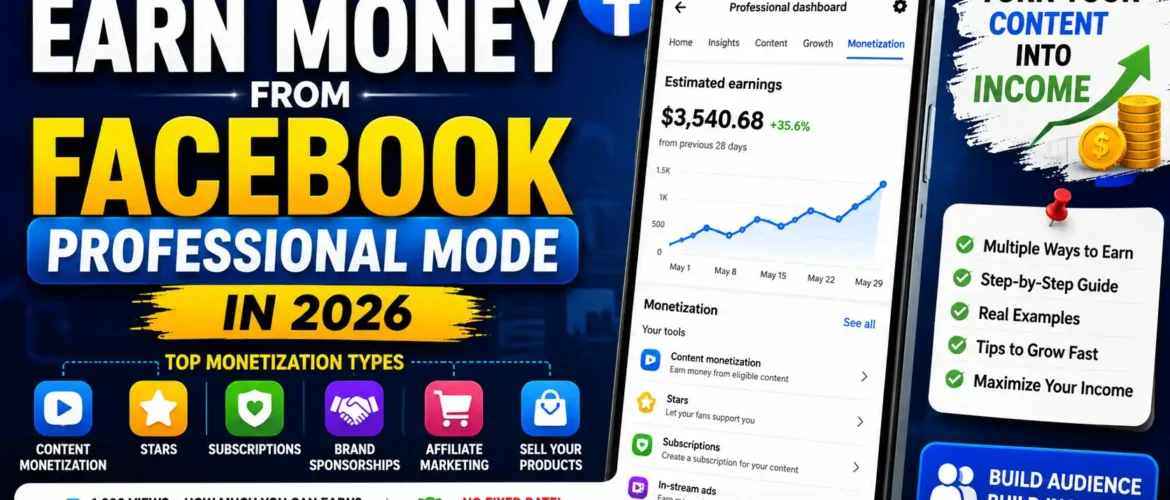
How to Earn Money from Facebook Professional Mode in 2026
Facebook has become more than a social networking platform. In 2026, creators can use Facebook Professional Mode to build a public audience, publish original content, and, when eligible, access Facebook’s monetization programs. Meta confirms that creators using professional profiles can access professional tools and monetization programs for eligible content.
However, turning on Professional Mode does not automatically mean you will start earning money. Monetization depends on your account’s eligibility, location, content, policy compliance, and the monetization products available to you.
What Is Facebook Professional Mode?
Professional Mode is a creator-focused setting for a Facebook profile. Instead of creating a separate Facebook Page, you can continue using your profile while gaining access to professional tools.
These tools can include:
- Professional Dashboard
- Follower and audience insights
- Content performance analytics
- Monetization information
- Creator tools
- Opportunities to earn from eligible content
Meta provides a specific process for checking monetization eligibility through the Professional Dashboard or Meta Business Suite.
For a person who regularly creates Reels, videos, photos, Stories, or text content, Professional Mode can therefore become an important part of a creator’s business.
How Do You Make Money With Facebook Professional Mode?
1. Facebook Content Monetization
One of the most important opportunities is Facebook Content Monetization.
Meta’s creator information states that eligible creators can earn from different content formats, including Reels, photos, Stories, and text posts.
This means you don’t necessarily have to depend only on long-form videos.
For example, imagine you create a digital marketing profile.
You publish:
“5 Free SEO Tools Every Business Owner Should Know”
The Reel receives 100,000 views.
If your account is eligible and the content generates monetizable results, Facebook may generate revenue from the eligible content. The amount is not guaranteed simply because the video received 100,000 views.
2. Facebook Reels
Reels are particularly useful for growing an audience because short-form content can reach people who don’t already follow you.
Good Reel topics include:
- Digital marketing tips
- AI tools
- Fitness tips
- Cooking
- Education
- Technology
- Business ideas
- Motivation
- Entertainment
- Travel
- Tutorials
For example:
Hook: “Your website isn’t ranking on Google? Check these 3 things.”
Then provide three useful tips and finish with:
“Follow for more SEO tips.”
The objective isn’t simply to collect views. You want viewers to become followers and eventually customers or supporters.
How Much Does Facebook Pay for 1,000 Views?
This is one of the biggest questions new creators ask.
The important answer is:
There is no fixed Facebook payment for every 1,000 views.
You should not assume that:
1,000 views = ₹X
for every creator.
Revenue can vary depending on factors such as the monetization program, eligible/monetized impressions, audience, content performance, advertiser demand and other factors.
Also, 1,000 views do not necessarily mean 1,000 monetized ad impressions.
Therefore, websites or videos claiming that Facebook always pays a specific fixed amount for 1,000 views should be treated cautiously.
Example Calculation
Suppose, purely as a mathematical example, a creator’s effective revenue were ₹50 per 1,000 monetized impressions.
Then:
| Monetized impressions | Hypothetical revenue |
|---|---|
| 1,000 | ₹50 |
| 10,000 | ₹500 |
| 100,000 | ₹5,000 |
| 500,000 | ₹25,000 |
| 1,000,000 | ₹50,000 |
These numbers are examples, not Facebook’s guaranteed rates.
Your actual earnings could be higher or lower.
The best way to understand your actual performance is to monitor the monetization information available in your Professional Dashboard.
3. Stars
Another potential income source is Facebook Stars, where eligible creators can receive support from their audience.
Stars can be particularly useful for creators who regularly interact with followers through:
- Facebook Live
- Gaming
- Educational sessions
- Q&A sessions
- Entertainment
- Community content
For example, a digital marketing creator could conduct:
“Free SEO Q&A – Ask Me Anything”
during a Live session.
If eligible viewers support the creator with Stars, this can become another revenue stream.
4. Subscriptions
Eligible creators may also be able to offer subscriptions.
For example:
Free Followers
- Public Reels
- Regular posts
- Basic tips
Paid Subscribers
- Exclusive videos
- Premium tutorials
- Subscriber-only posts
- Special Q&A sessions
- Additional resources
Suppose, hypothetically, 500 subscribers pay ₹99 per month:
500 × ₹99 = ₹49,500
That is a simple gross-revenue example before applicable fees, taxes, refunds or other deductions.
Availability and terms depend on the features offered to your account.
5. Brand Sponsorships
You don’t have to depend entirely on Facebook’s own monetization.
Once you develop a valuable audience, companies may pay you to promote their products or services.
For example, a creator with a digital marketing audience could partner with:
- SEO software companies
- Website hosting companies
- AI tool companies
- Marketing agencies
- Training companies
- Business software companies
A sponsored Reel might say:
“3 AI Tools That Can Save Digital Marketers Hours Every Week.”
The company pays the creator for the agreed promotional campaign.
This is especially useful because a smaller but highly targeted audience can sometimes be more valuable to a business than a huge audience with little relevance.
6. Affiliate Marketing
Affiliate marketing is another way to turn Facebook traffic into income.
Suppose you create:
“Top 5 SEO Tools for Beginners.”
You recommend five products and use approved affiliate links.
Imagine:
- 1,000 people click
- 50 people purchase
- Average commission = ₹500
Your hypothetical commission:
50 × ₹500 = ₹25,000
This income comes from the affiliate program, not directly from Facebook’s view payment.
Always follow applicable disclosure and platform rules when promoting affiliate products.
7. Sell Your Own Products and Services
For businesses and professionals, this can be even more powerful than advertising revenue.
For example, a digital marketing trainer could use Facebook Professional Mode to promote:
- Digital Marketing Courses
- SEO Courses
- Google Ads Services
- Social Media Marketing
- Website Development
- SEO Consulting
- Content Marketing
- Graphic Design Services
Example
A Reel receives only 20,000 views.
From those views:
- 500 people visit your profile
- 100 people send enquiries
- 20 people attend a webinar
- 5 people purchase a ₹10,000 course
Revenue:
5 × ₹10,000 = ₹50,000
In this example, the creator’s biggest opportunity isn’t the direct Facebook view revenue. It is converting the audience into customers.
8. Facebook Live
Live video can help creators build trust and community.
For example:
Every Saturday – Digital Marketing Live Q&A
You could answer questions about:
- SEO
- Google Ads
- Instagram marketing
- Facebook marketing
- WordPress
- AI tools
Depending on the features available to your account, Live content can support monetization through eligible tools such as Stars, subscriptions, sponsorships or sales.
What Determines Facebook Earnings?
Your revenue can vary because of several factors.
Audience Location
Advertiser demand differs between countries and audiences.
Content Quality
Useful, original and engaging content is generally a better foundation for long-term growth than copied or low-value content.
Watch Time and Engagement
Strong viewer retention, shares, comments and repeat viewers can help build a more valuable audience.
Content Category
Different niches can attract different levels of advertiser interest.
Monetization Eligibility
Having 10,000 followers or millions of views does not automatically guarantee access to every monetization feature. Your specific Professional Dashboard is the best place to check your eligibility.
Policy Compliance
Meta says content must meet its monetization policies to qualify for certain monetization products.
How to Start Facebook Professional Mode
If Professional Mode is available on your profile, the general process is:
- Open your Facebook profile.
- Find the option to turn on Professional Mode.
- Enable Professional Mode.
- Complete your professional profile.
- Select a clear content niche.
- Start publishing original content.
- Build followers and engagement.
- Open the Professional Dashboard.
- Check the Monetization section.
- Review any eligibility requirements.
- Complete payout information when Facebook makes it available.
- Continue creating policy-compliant content.
Meta provides tools to check whether a Facebook profile or Page is eligible for monetization.
How to Grow Faster
If you are starting from zero, don’t post random content.
Choose one niche.
For example:
Digital Marketing + AI + SEO
Then create a content schedule:
Monday: SEO Tip
Tuesday: AI Tool
Wednesday: Digital Marketing Tutorial
Thursday: Facebook/Instagram Marketing Tip
Friday: Case Study
Saturday: Live Q&A
Sunday: Weekly Marketing Update
You can also repurpose a single topic into multiple formats.
For example:
Topic: “Keyword Research”
Create:
- 30-second Reel
- 2-minute video
- Text post
- Infographic
- Story poll
- Live Q&A
This gives you multiple opportunities to reach your audience.
Avoid Fake Views and Followers
Don’t try to shortcut growth with:
- Purchased followers
- Fake views
- Bots
- Engagement manipulation
- Copyrighted videos
- Re-uploaded content without meaningful originality
- Misleading content
Build a genuine audience instead.
The goal should be:
Content → Views → Followers → Trust → Enquiries → Customers → Revenue
A Realistic Facebook Income Strategy
Don’t depend on one income source.
A creator could build this model:
Stage 1 – 0 to 1,000 followers
Focus mainly on quality content and audience growth.
Stage 2 – 1,000 to 10,000 followers
Experiment with different formats and build a recognizable niche.
Stage 3 – 10,000+ followers
Explore eligible Facebook monetization features, affiliate marketing, sponsorships and product/service sales.
Stage 4 – Established audience
Build multiple income streams instead of relying exclusively on Facebook’s advertising revenue.
Final Conclusion
Facebook Professional Mode can be a powerful opportunity for creators and businesses in 2026. Meta provides professional tools for profiles and monetization opportunities for eligible content, while Facebook Content Monetization supports multiple content formats.
But the most important lesson is:
Don’t chase views alone. Build an audience and a business.
Your potential income can come from:
- Facebook Content Monetization
- Reels and eligible video content
- Stars
- Subscriptions
- Brand sponsorships
- Affiliate marketing
- Courses
- Products
- Services
- Consulting
And remember: there is no guaranteed fixed amount that Facebook pays for 1,000 views. Actual monetization depends on your eligible monetization features and performance.
If your goal is to earn ₹50,000, ₹1 lakh or more per month, a better strategy is to combine Facebook monetization with sponsorships, affiliate income and your own products or services rather than depending only on ad revenue.
Check your Professional Dashboard regularly, because Facebook’s available monetization features and eligibility requirements can change. Meta’s official resources provide the current eligibility and policy information.
Social Media Optimization Course – Enroll Now